




POLAR LAB
INTEGRATED FACILITY (IF)



The Polar Lab is a novel research, training, and awareness facility that hinges on infrastructure sharing and interdisciplinarity.
The Polar Lab Integrated Facility (IF) is structured around the establishment of the first sub-zero, temperature-controlled laboratory in Africa, for the simulation of the Antarctic and sub-Antarctic environment for experimental and training purposes. This innovation will bring new opportunities for polar research in Africa.
The goal of the Polar Lab is to implement infrastructure and equipment that will generate a transformed, internationally competitive and sustainable research workforce through the training of students and scientists in polar sciences both on the African continent and in the field.
The Polar Lab aims to be a physical, local space that increases the proximity to remote spaces and our capability for decision making through digital technology and infrastructures.
The Polar Lab will simulate the polar environment conditions by means of dedicated cold rooms and an ice-wave tank for seawater experiments, which would be one of the few in the world. It also includes the implementation of mobile polar labs that can be used both in South Africa and at sea.
The Polar Lab will enable researchers to experiment with the polar environment at any time of the year under controlled sub-zero temperatures – regardless of how warm it is outside. It will combine the experience garnered at other international cold laboratories to allow the reproduction of polar physical conditions, such as ice growth, sea ice-water-wave interactions, and biological habitats to conduct assays and incubations.
HOST OF THE POLAR LAB

University of Cape Town (UCT)
IMPACT OF THE POLAR LAB
The Polar Lab will promote and facilitate multidisciplinary, collaborative research across South Africa and Africa. The Polar Lab provides an opportunity for increased exposure and training in polar science and technology for students, scientists, and technicians – eliminating the necessity of travelling to Antarctica and participating in research cruises, as this is not always feasible.
The Polar Lab will allow learners and the wider public to immerse themselves in the polar environment.
For more information about the Polar Lab IF, refer to Section 2.2.3 Polar Lab in the SAPRI Proposal (2021).
POLAR LAB INFRASTRUCTURE
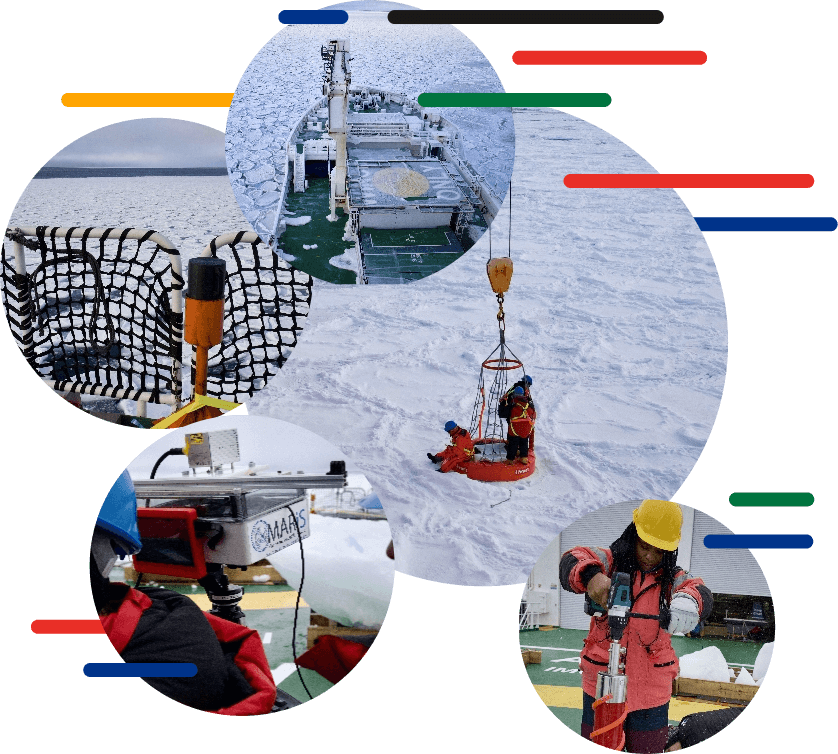
Infrastructure support includes
- Mobile polar labs
- Processing of temperature sensitive samples
- Conducting experiments under temperature and light controlled conditions
- Ability to be used aboard the S.A. Agulhas II during research expeditions
- Testing and calibration of sensors and infrastructure (equipment) in temperature-controlled environments
- Preservation of ice and temperature-sensitive samples
- Storage of medium- and long-term temperature-sensitive specimens and geological samples
- Processing of temperature-sensitive samples
- Conducting experiments in controlled environments
- Represent an essential platform for designing and testing innovative instruments and sensors for studying the polar environment
- Equipment and gear for measuring the physical, biological and chemical properties of ice in the field (ice research)
POLAR LAB RESEARCH AREAS
The Polar Lab will support polar research activities across science and engineering disciplines and allow personnel to undertake research that is currently not possible in the country and the continent.
These include
- Artificial sea ice creation in a wave tank
- Study of wave-ice interactions and damping of pancake ice and interstitial frazil ice
- Study of biological uptake, production and gas exchanges in natural and artificially created sea ice
- Study of atmosphere-ice-ocean interaction in artificially created sea ice
- Sub-zero testing and analysis of physical, mechanical and biogeochemical properties of Antarctic and artificial sea ice samples
- Sub-zero testing and analysis of physical and mechanical properties of Antarctic geological samples
- Near-zero and sub-zero experiments with biological specimens from the polar ocean, sub-Antarctic islands and the Antarctic continent
MEET THE POLAR LAB TEAM

Dr Riesna R. Audh
Polar Lab Research Coordinator
University of Cape Town (MARiS Centre)


Prof Marcello Vichi
Polar Lab User Fora Chair
Dept. of OceanographyUniversity of Cape Town
CONSORTIUM PARTNERS & STAKEHOLDERS

MARiS is officially recognised as the interdisciplinary centre for marine and Antarctic scientific research, involving multiple departments within UCT: Biological Sciences, Chemical Engineering, Electrical Engineering and Oceanography.


FEATURED NEWS

NRF-SAEON, SAPRI and SOMISANA bring South African marine offshore and polar research to the SANSA Space Science Open Day
The South African National Space Agency (SANSA) Space Science Open Day brought together members of the public, scientists, researchers, and educators in Hermanus for a day of discovery, exploration and engagement with science. The South African Polar Research...
SAPRI celebrates Heritage Day with a public lecture
In celebration of Heritage Day, we collaborated with the Iziko South African Museum on its In_Herit Festival 2026: Public Lecture Series. As part of the series, our LTO-Land Research Coordinator, Abuyiselwe Nguna (fondly known as Abu), delivered a public lecture on 19...
The NRF-SAEON Egagasini Node and SAPRI at the 19th Pujiang Innovation Forum in Shanghai, China
The NRF-SAEON Egagasini Node and its research infrastructure, the South African Polar Research Infrastructure (SAPRI), were part of the Department of Science, Technology and Innovation (DSTI) South African delegation at the 19th Pujiang Innovation Forum in Shanghai,...