
Local and global importance of monitoring killer whales
The monitoring of killer whales (Orcinus orca) at Marion Island is of great importance both locally and globally. The work done by the South African Polar Research Infrastructure (SAPRI) on Marion Island continues the work of the Marion Island Marine Mammal Programme (MIMMP) and contributes to global research initiatives that look at the understanding of the role of apex predators within the region.
Monitoring such apex predators enables us to understand more about how these animals influence the ecosystem by acting as a regulating force for prey populations, thereby maintaining a balance in the marine ecosystem.
Our work allows us to track killer whale population sizes by knowing which individuals are present, if there are any new calves, and where the animals are seen around the island. We can also study the population dynamics within the different family and social groups, the compositions of which change in response to the seasonal availability of prey species (southern elephant seals, Antarctic and sub-Antarctic fur seals, and penguins).
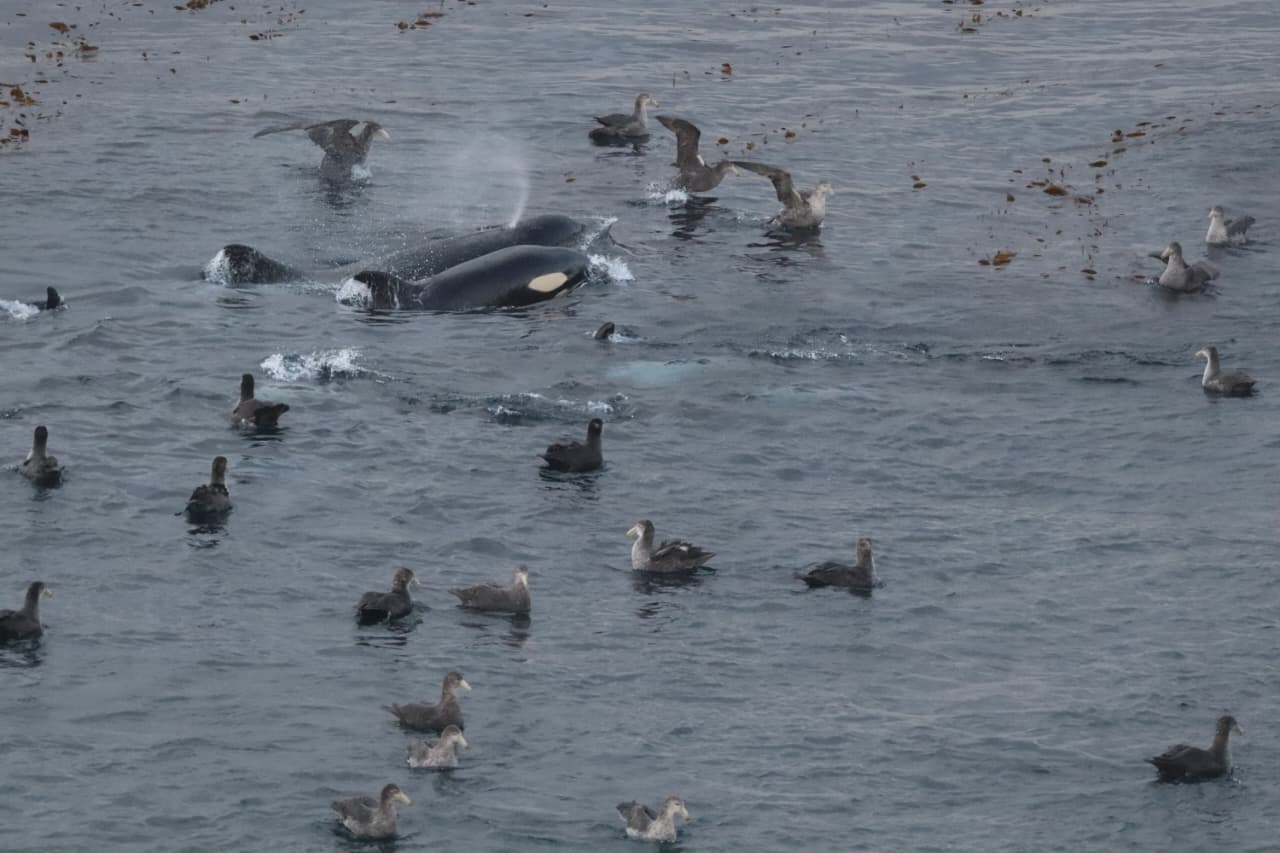
Ebony (M029), an adult female, and her calf Echo (M075) surface amid a successful hunt near the research station on Marion Island (photo by Chandler Patel)
My role as a killer whaler
As a SAPRI killer whaler, I monitor the presence and behaviour of the killer whales that visit Marion Island by conducting observations from a rock on the coast near the base called Kill Point in Rockhopper Bay. During these observations, I spend hours staring out at the ocean waiting to see approaching killer whales.
What does a killer whale observation session entail?
You stare out at the sea, hoping to turn your head at just the right moment to spot approaching killer whales, if they do in fact decide to visit that day. During killer whale observations, you stand or sit ready with a camera, your head on a swivel as you look from landmarks called Duiker’s Point to Cabbage Point, scanning the ocean surface for any sign of approaching killer whales.
What are the signs that I look out for?
The most direct sign is simply seeing the animals approaching – their fins knifing the water’s surface, or the animals blowing water from their blowholes. It could also be the presence of air bubbling up to the surface from the depths. Other signs are less direct, such as seeing a large gathering of seabirds on the water’s surface. This tells you that the killer whales are not only present, but have successfully hunted something in the water.
What happens when the killer whales appear?
When the killer whales are present, I note the time they pass by, their distance from the coastline, and ready my camera to take as many photos as needed to successfully identify the individuals that are there. Additionally, I note the different behaviours I witness the group or individuals performing as they pass Kill Point.
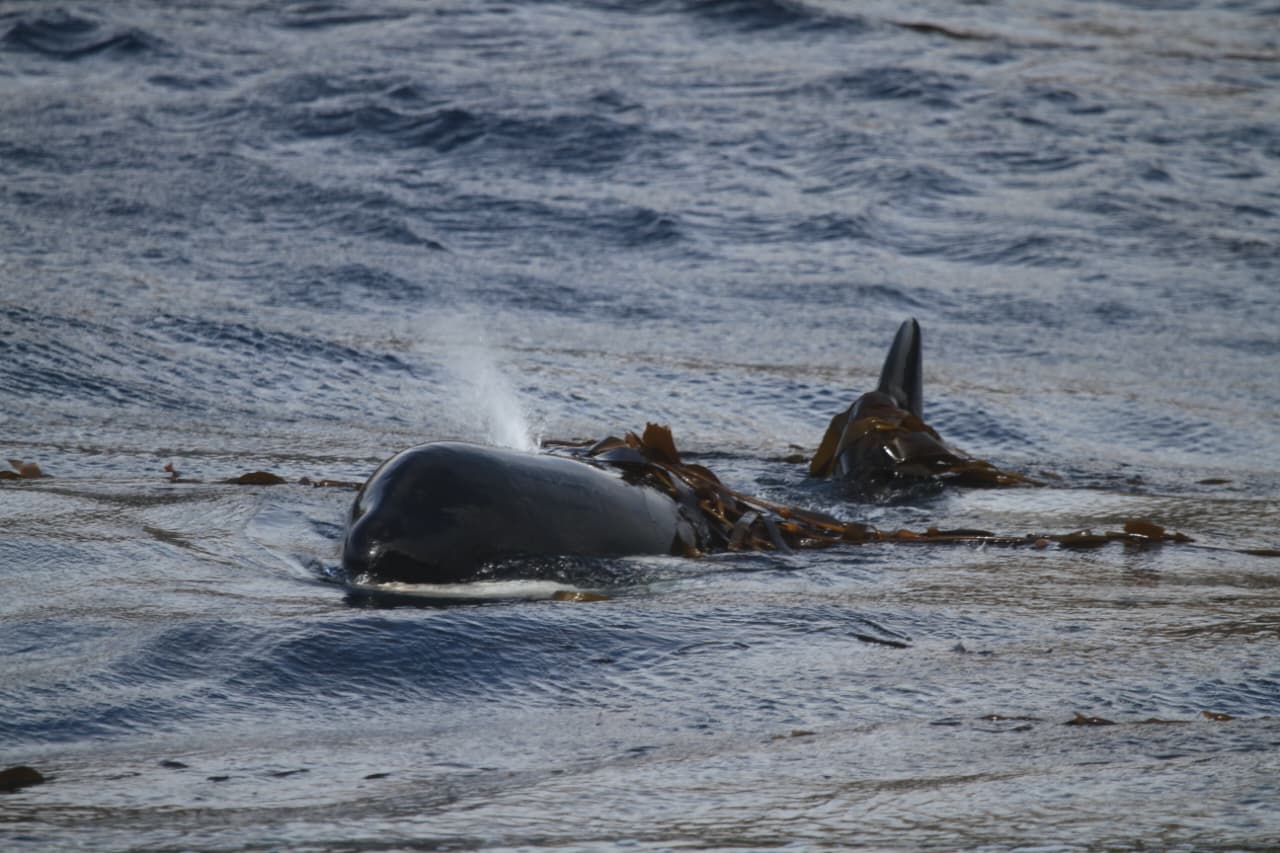
Seabiscuit (M027), an adult female, playing with kelp stalks in Rockhopper Bay (photo by Chandler Patel)
Sightings of killer whales make up only a small portion of the time I spend at Kill Point, as they rarely remain in the bay for more than 20 minutes. The rest of the time is spent recording changes in environmental conditions such as cloud cover, glare on the ocean, changes in wind speed or direction, and whether it rains, snows, hails, or any other weather phenomenon that could influence the quality of the images taken.
There have been multiple observations in a row where no killer whales arrive at Kill Point, but there have also been days with up to eight sightings, each with different individuals or a different composition of individuals compared to when the pod last passed.
To identify an individual during a sighting, I ideally obtain a clear photo of the fin, as this feature is unique to each individual. Every fin is different, with each animal bearing its own marks, scratches, and notches. Some animals can be very difficult to tell apart, but I can also compare markings on other parts of the body, such as the saddle patch or eye patch, and the group composition also helps with identifying an animal.
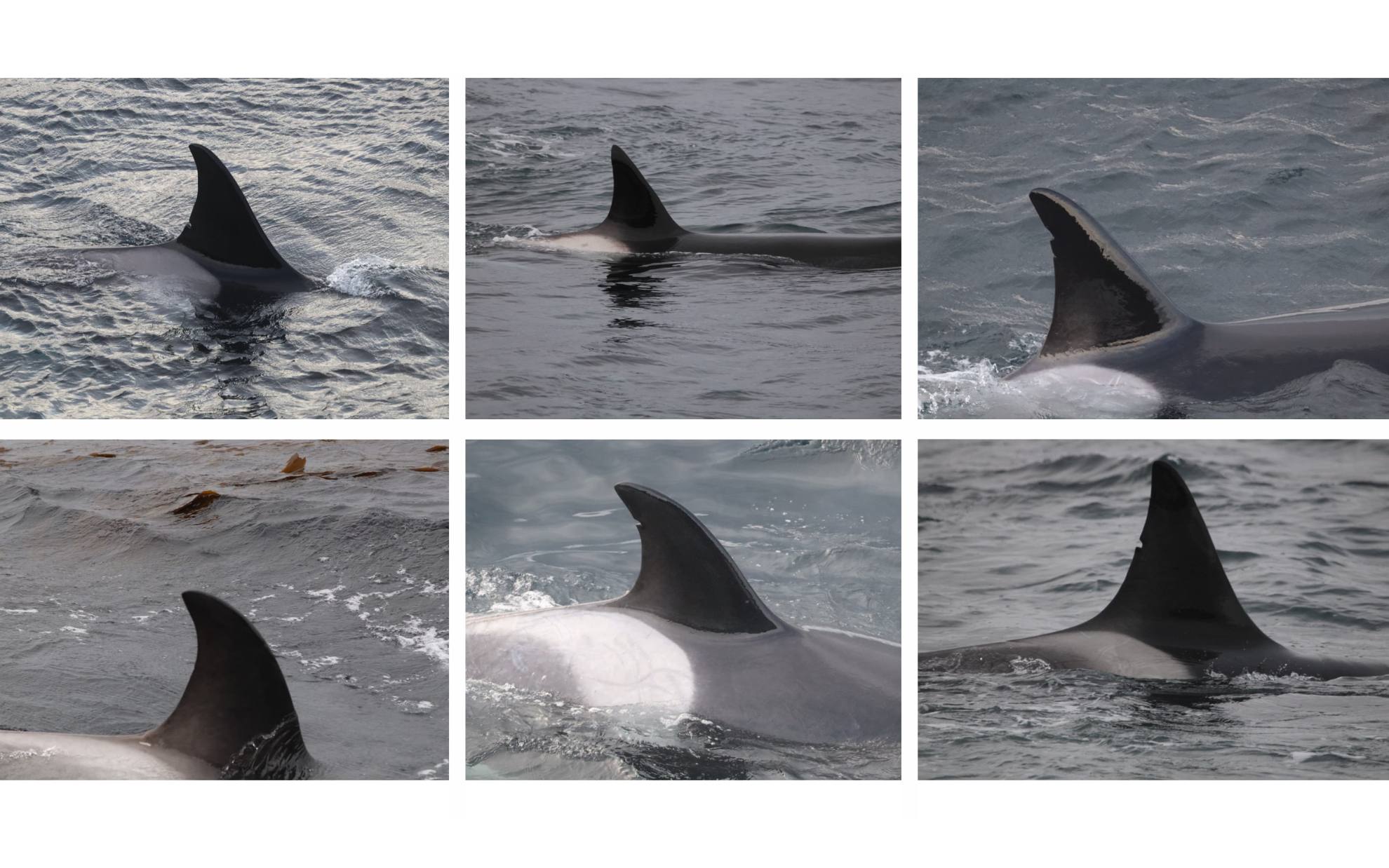
Killer whale dorsal fins are used for identifying individuals. Clockwise top L to bottom L: Ebony (M029), Dot (M004), Ivory (M034), Angle-Fin (M049), Ella (M062), Ringo (M066) (photos by Chandler Patel)
Interesting things I have observed
I have had the privilege of witnessing a wide range of behaviours from Marion’s killer whales, and through continued observation have become familiar with the behaviours and personalities of individuals that frequent the island. I find it amazing to watch a familial group change their behaviour from active foraging to playing with the youngest, creating teachable moments for the calves as they interact with other animals. I have had calves slow down as they approach Kill Point and roll onto their sides to look up at me while I look down at them. I have seen juveniles form their own social pod and travel ahead of their parents to explore on their own.
I have looked into the eyes of adults as they lift their heads out of the water to look at the strange human waving at them as they swim past. These interactions I have had with the killer whales are what make the many cold hours at Kill Point so worthwhile.
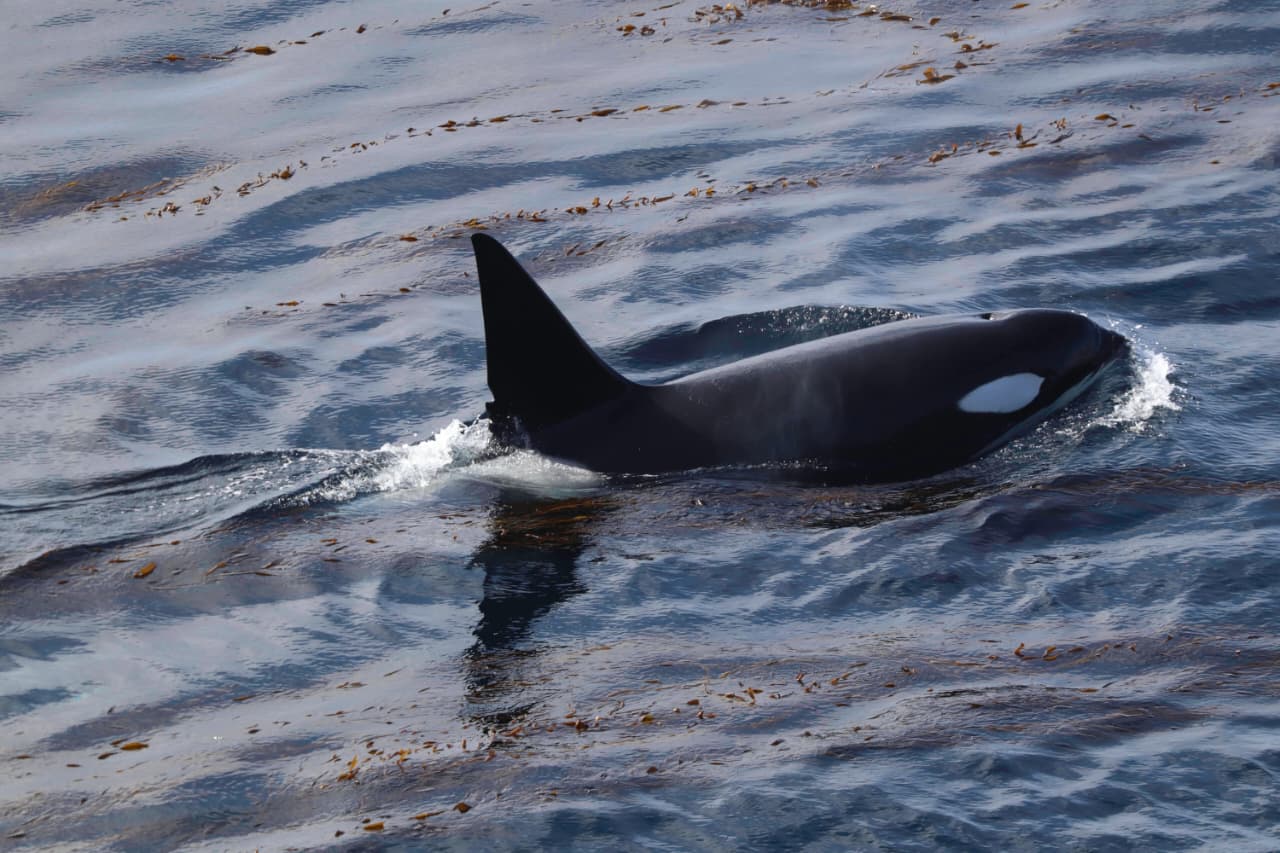
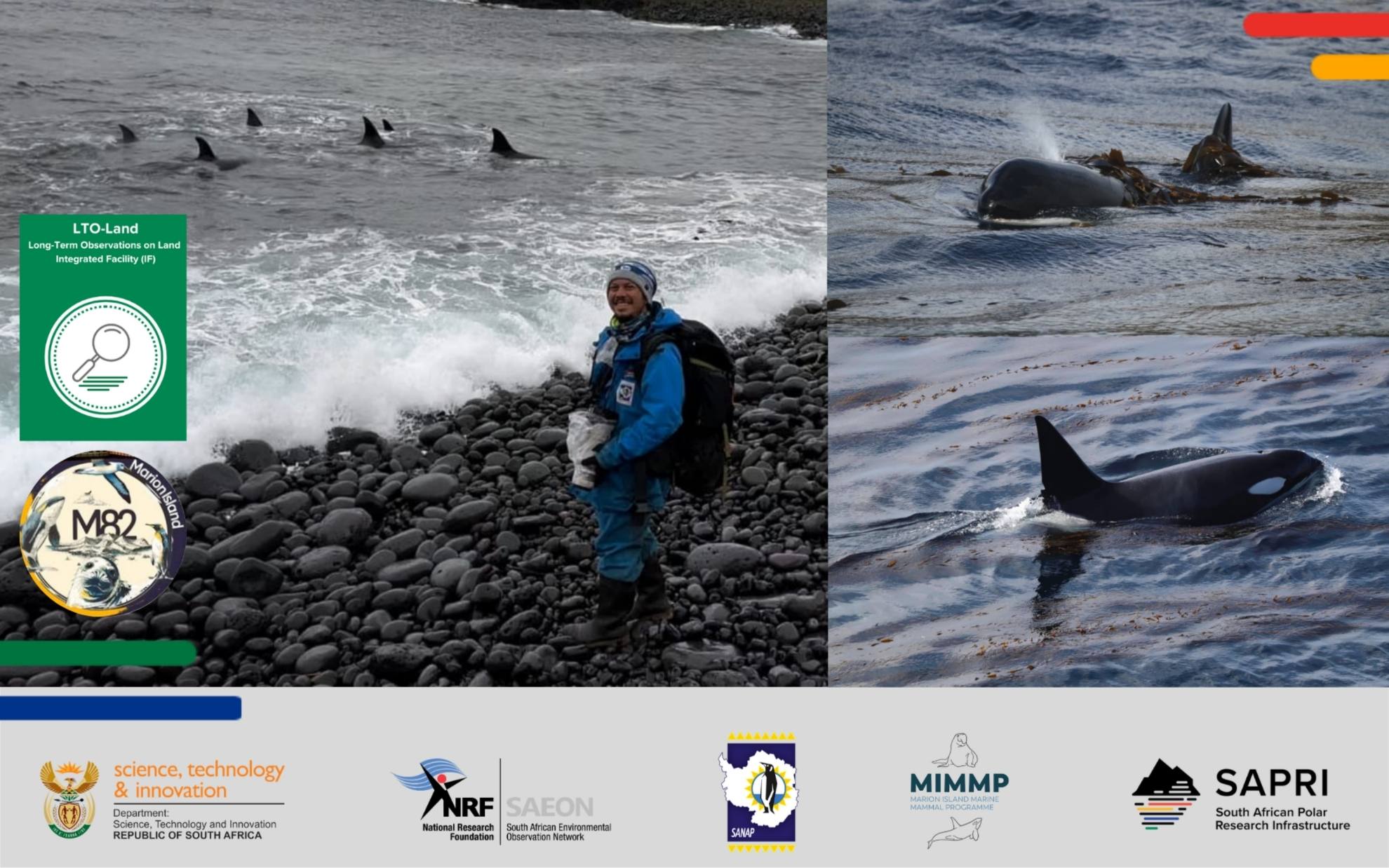
Halfmoon (M001), an adult male, cruising past the Marion Island research station ahead of the pod he was travelling with on the day (photo by Chandler Patel)
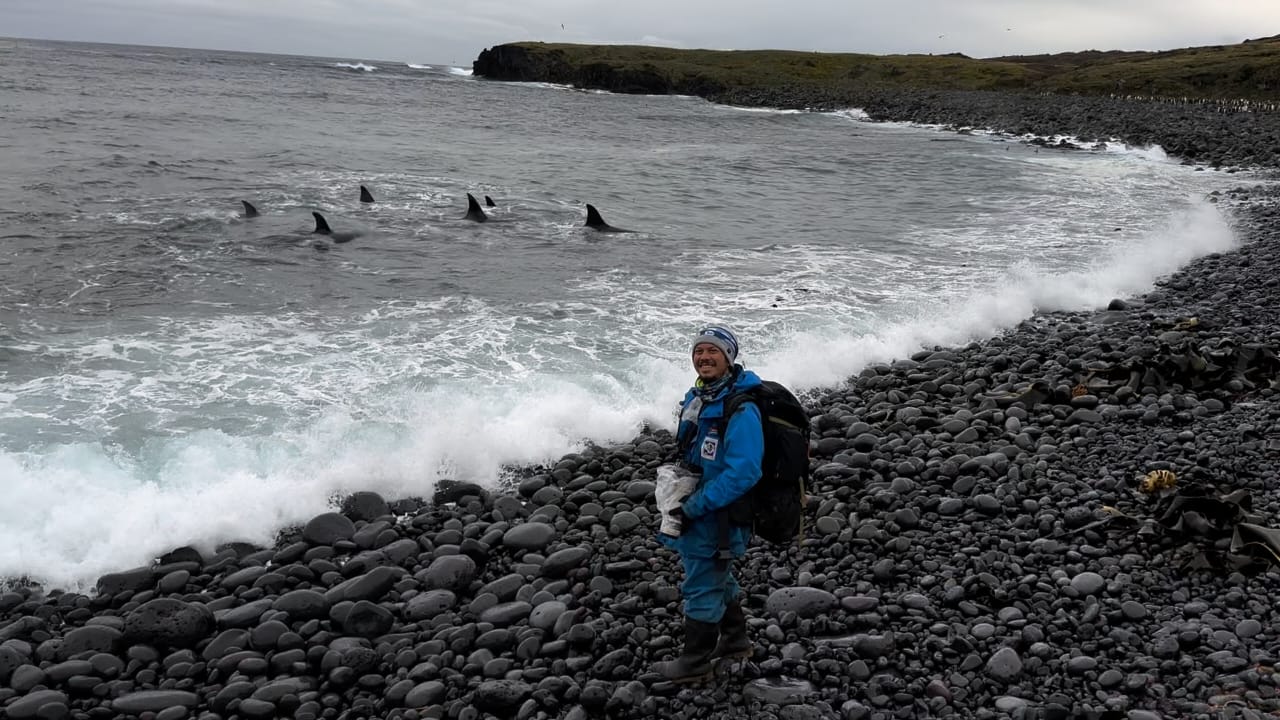
Chandler Patel, SAPRI Killer Whale and Seal Field Researcher overwinterer, on Marion Island (photo by Camilla Smyth)
Written by Chandler Patel, SAPRI Killer Whale and Seal Field Researcher
Anne Treasure, South African Polar Research Infrastructure, 18 March 2026