
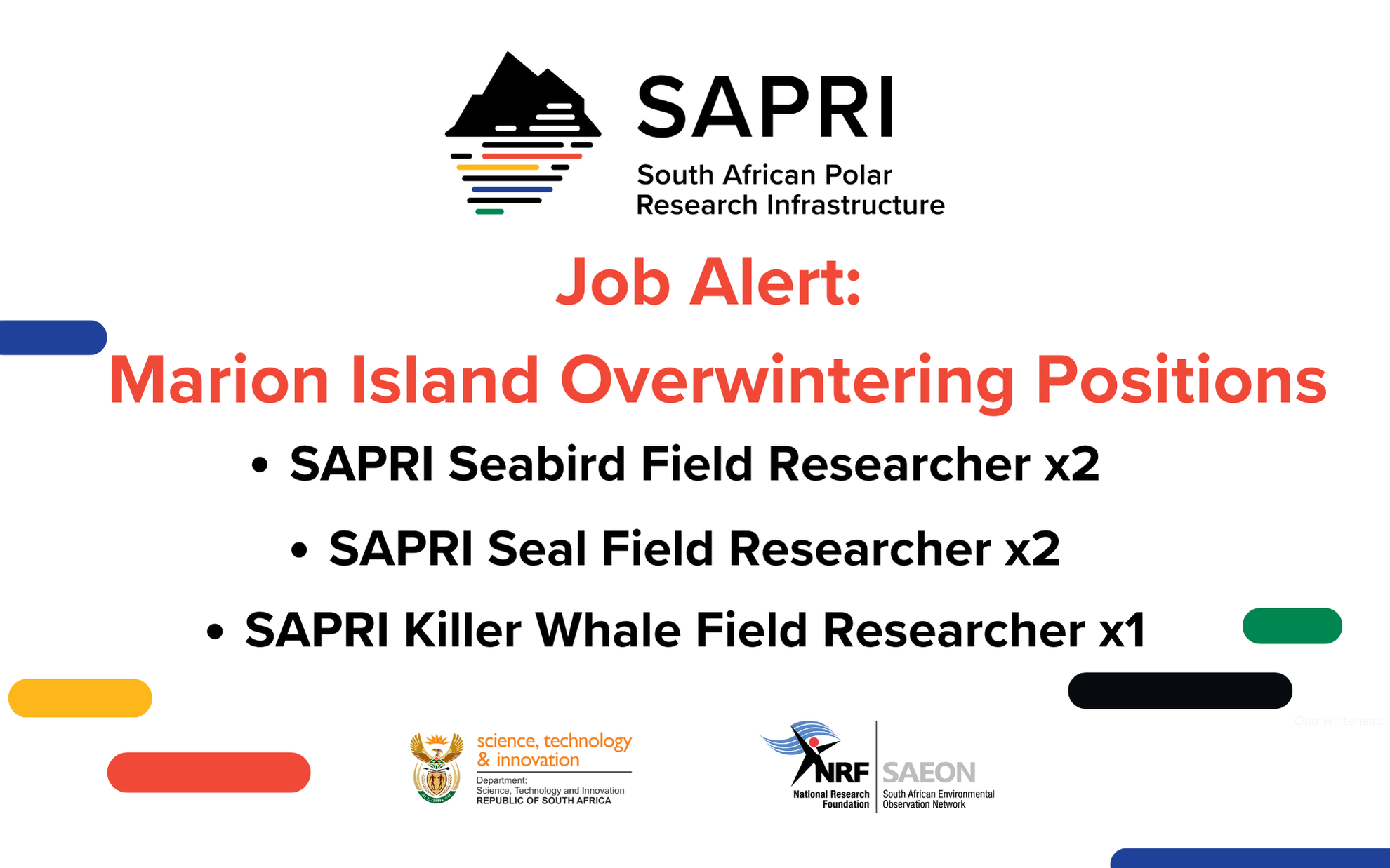
Applications open for:
- Overwintering Seabird Field Researcher (Birder) (2x positions)
- Overwintering Seal Field Researcher (Sealer) (2x positions)
- Overwintering Killer Whale Field Researcher (Killer Whaler) (1x positions)
The South African Environmental Observation Network (SAEON) Egagasini Node, based in Cape Town, Western Cape, requires the services of suitably qualified individuals to be responsible for collecting field data on seabirds (i.e., Albatrosses and Petrels), 3 seal species, and killer whales to be used for conservation and academic purposes as part of the South African Polar Research Infrastructure (SAPRI).
All overwinterer positions involve undertaking fieldwork under very rigorous and extreme conditions (cold, wet and windy 95% of the time). Meticulous observation, note-taking and record-keeping abilities are important. As is being able to manage large electronic datasets, electronics, (e.g. satellite relay data loggers) and a storage facility.
As per job advertisement:
Key Responsibilities for the Birder position:
- Collecting field data on surface-nesting seabirds including albatrosses and giant petrels to be used for conservation and academic purposes
- Carrying out physiology work with petrel and albatross nestlings including handling, blood sampling and isotope work
- Collecting behaviour observations on nestlings of surface-nesting albatrosses and giant petrels
- Monitoring nestling survival in Wandering Albatrosses
- Deploying and maintaining camera traps and temperature dataloggers
- Assisting with monitoring of long-term study populations of petrels and albatrosses when necessary
- Remote field work without direct supervision
- Field work will encompass 75% of the time, with a lot of walking (4000 – 6000km) in gumboots during the contract time frame
- Data capturing, analysis, and reporting
- Rigorous outdoor activity in harsh conditions (low temperatures, gusty winds and rain)
- Management of equipment (asset management)
- A valuable and friendly member of the team at Marion Island Base
Key Responsibilities for the Sealer position:
- Counting, handling, sampling, mark-recapture of seals
- Satellite device deployment and removal, weighing, sampling, measuring, observations
- Remote field work without direct supervision
- Field work will encompass 65% of the time, with a lot of walking (4000 – 6000km) in gumboots during the contract time frame
- Office and laboratory work for sample management and data analysis
- A large proportion of time is allocated to assisting with dedicated Killer whale observations
- Data capturing, analysis, and reporting
- Rigorous outdoor activity in harsh conditions (low temperatures, gusty winds and rain)
- Management of equipment (asset management)
- A valuable and friendly member of the team at Marion Island Base
Key Responsibilities for the Killer Whaler position:
- Monitoring and data collection of killer whales and assistance with seal work
- This includes: behavioral observation, photographic mark-recapture, satellite device deployment, biopsy sampling and measurements
- Satellite device deployment and removal, weighing, sampling, measuring, observations
- Remote field work without direct supervision
- Field work will encompass 65% of the time, with a lot of walking (4000 – 6000km) in gumboots during the contract time frame
- Office and laboratory work for sample management and data analysis
- A large proportion of time is allocated to assisting with dedicated sealer observations
- Data capturing, analysis, and reporting
- Rigorous outdoor activity in harsh conditions (low temperatures, gusty winds and rain)
- Management of equipment (asset management)
- A valuable and friendly member of the team at Marion Island Base
About The Employer:
The National Research Foundation (NRF) supports and promotes research and human capital development through funding, the provision of National Research Facilities and science outreach platforms and programmes to the broader community in all fields of science and technology, including natural sciences, engineering, social sciences and humanities. The South African Environmental Observation Network (SAEON) is a research platform funded by the Department of Science, Technology and Innovation (DSTI) and managed by the National Research Foundation (NRF) since 2002. SAEON is mandated to observe and research ecosystems on land, in coastal regions and the oceans to understand how those systems function and might change over time and space when influenced by socio-economic driving forces including climate change. We deliver our data online and offer tools, services and advice for informed environmental policy-making.
The Marion Island research station is managed and administered by the Department of Forestry, Fisheries and the Environment (DFFE).
Apply before 9 September 2025:
Rabia Mathakutha, South African Polar Research Infrastructure, 26 August 2025