
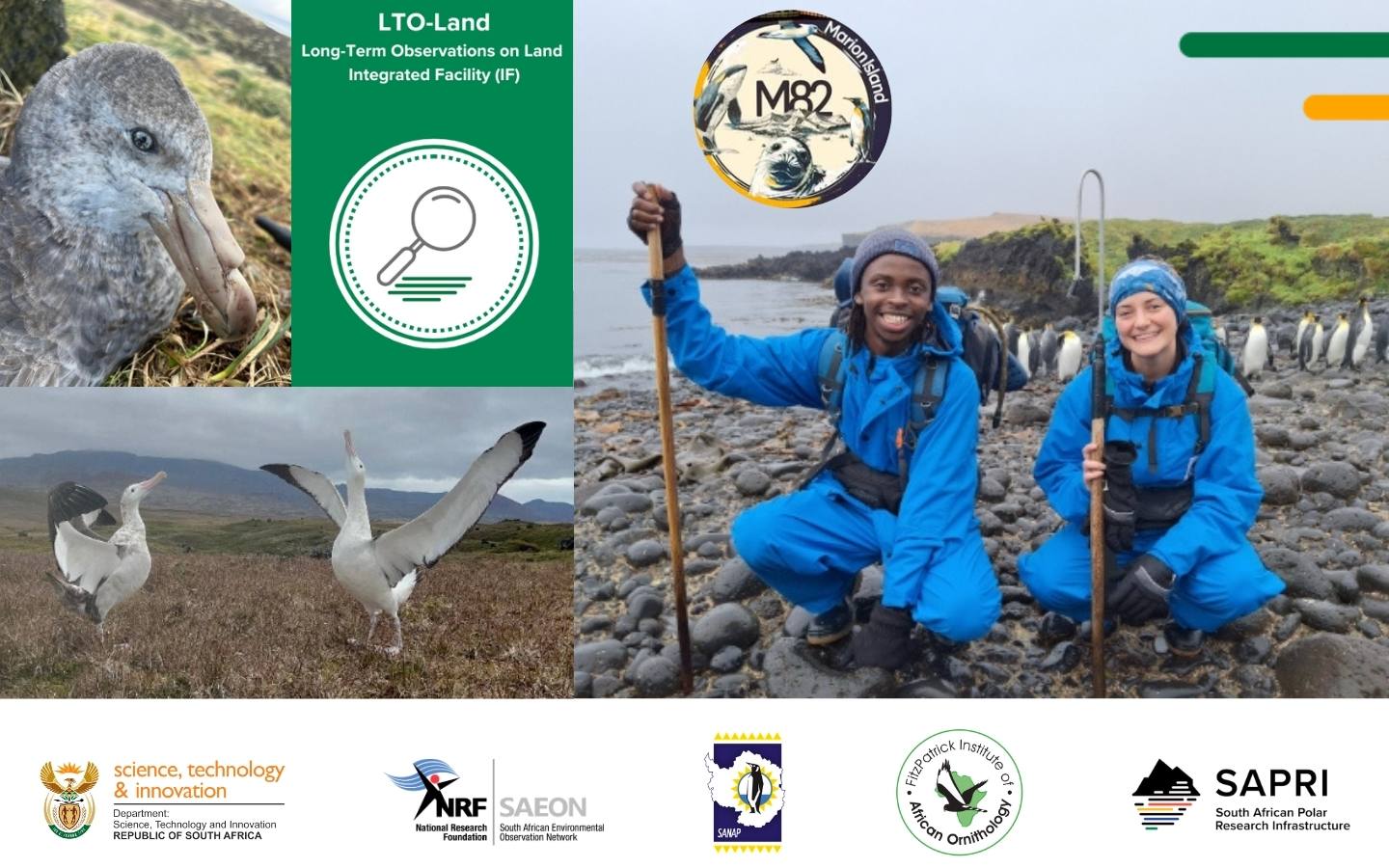
Every year from August to April, Marion Island transforms into a bustling seabird nursery. This remote volcanic island in the sub-Antarctic provides a critical breeding refuge for thousands of pelagic seabirds that spend most of their lives roaming the open ocean.
The work of the SAPRI seabird field researchers mainly focuses on closely monitoring Wandering Albatrosses, Grey-headed Albatrosses, and Northern Giant Petrels. These are species that act as sentinels of the seas, revealing the health of marine ecosystems on a global scale.
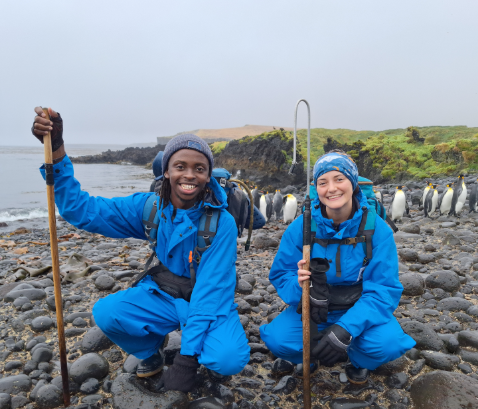
Andile Kuzwayo (L) and Jana Rau (R), SAPRI birders, 2025-2026
Why Marion Island matters
Seabirds are powerful indicators of environmental change. As long-lived, wide-ranging top predators, they respond rapidly to shifts in food availability, environmental and climate change, pollution, and fisheries pressure. Changes observed on Marion Island therefore provide insight into processes unfolding across the Southern Ocean. Given that seabirds are among the most threatened bird groups globally, long-term monitoring is essential for informing conservation action and deepening our understanding of human impacts on marine ecosystems.
Wandering Albatross: ocean giants
The Wandering Albatross, or ‘Walbies’, are simply magnificent. With wingspans that can reach up to 3.5 m, the largest of any flying bird on Earth, their fly-overs sound like a low-flying aircraft. Marion Island and nearby Prince Edward Island host an astonishing 44-47% (i.e. almost half) of the global breeding population!
Walbies often mate for life, and perform elaborate courtship dances involving screeching, bill clapping, bubbling calls, and open-wing displays. They typically breed every second year, lay a single egg per breeding attempt, and can live for more than 50-60 years, traveling an estimated 8.5 million kilometres over their long lifetimes. We regularly come across large males that are easily 9-16 years older than us!
Main results for the 2025 season include:
- 81.7% hatching success
- 77.4% fledging success
- 63.2% overall breeding success
This breeding success for 2025 is positive, being the second highest success over the last decade. We hope this positive trend will continue for this Vulnerable species. Breeding success on the island has fluctuated in the last 10 years, with the lowest breeding success being in 2024 possibly due to the devastating effects of the Highly Pathogenic Avian Influenza (HPAI) outbreak. In January 2026, we went on a quest to locate all the Walbie eggs on the island … and after ~500 km hiked cumulatively, 2 776 eggs were found.
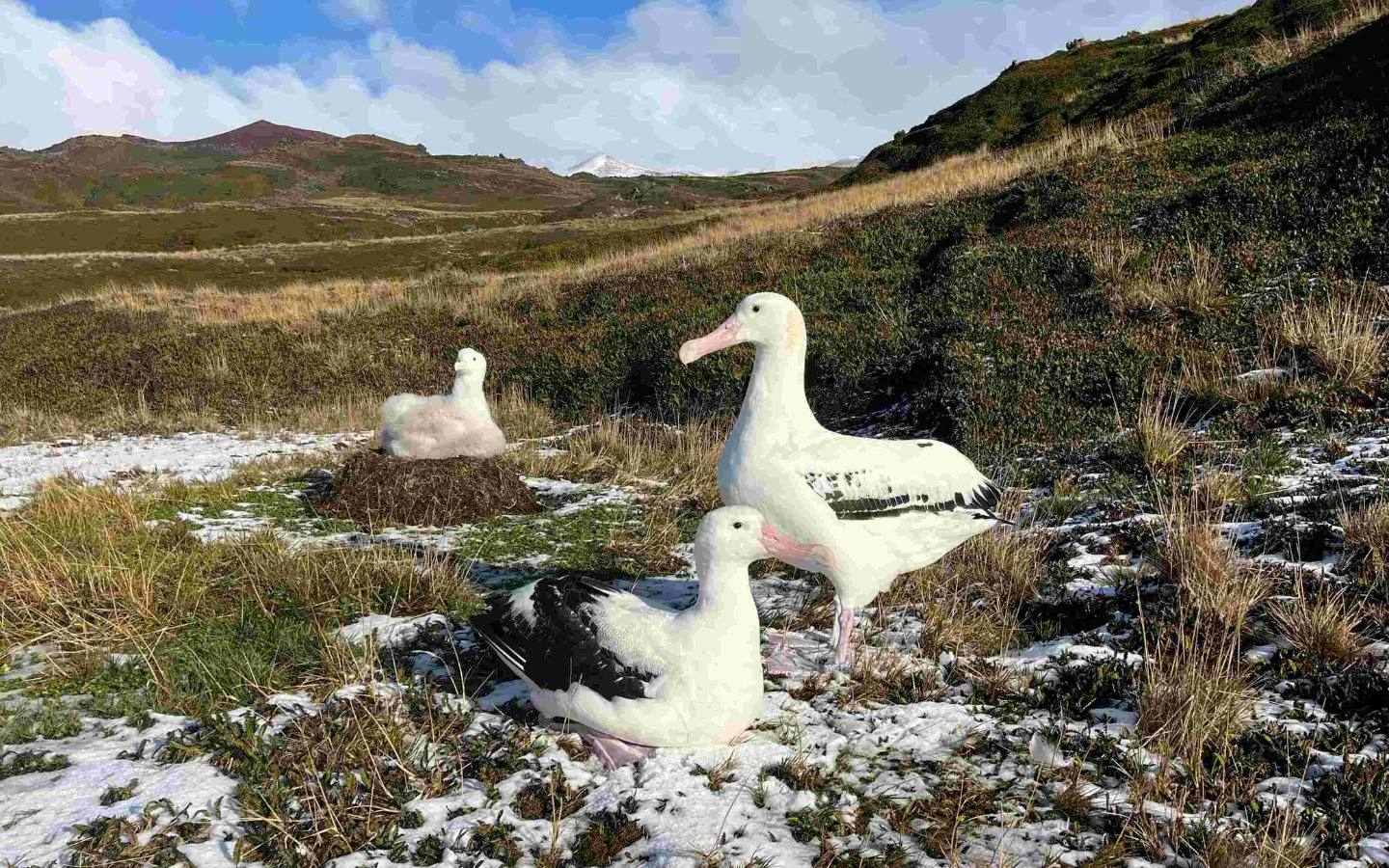
Wandering Albatross adults with chick on Marion Island
Monitoring involves visiting roughly 370 nests every 14 days in specific colonies. For all our species, checks include marking nest locations, and closely monitoring laying, hatching and fledging outcomes, chick and adult health, ring numbers, plastic pollution, and signs of mouse activity. Ringing is a main task for us, as it allows us to identify and track individual birds over their lifetimes. Ringing albatrosses and petrels is an unforgettable and special experience. Not only because you are faced with a snapping bill that can grow to ~19 cm long but also because chicks defend themselves by projectile vomiting fish-oil-rich stomach contents that never quite washes out of clothing … “Marion perfume” anyone?
A major threat to all our birds remains invasive house mice, which inflict severe, often fatal wounds on chicks and adults, with some injuries so severe they expose bone. Mouse eradication is one of the most urgent conservation priorities on the island.
Grey-headed Albatross: cliff side specialists
Grey-headed Albatrosses, strikingly beautiful birds with colourful bills and sleek plumage straight from the “featherdresser” (hence their genus name, chrysostoma, meaning “golden mouth”), breed in dense colonies on steep, muddy ridges only a quick ~20 km hike away from Marion Base.
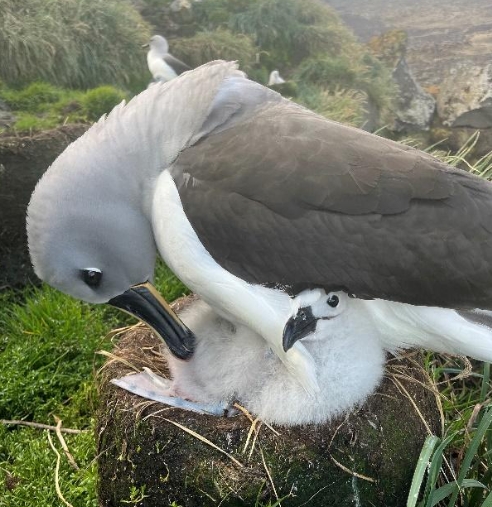
Grey-headed Albatross adult with chick on Marion Island
Adults build impressive nest mounds by patiently gathering mud and vegetation, then cementing the material together by tapping it with their beaks. Once the chicks hatch, they are brooded by their parents until they are large enough to thermoregulate by themselves. After this period, the adult will remain next to the chick to guard it for a short while before leaving it to fend for itself. Adults return to feed the chicks via regurgitation until big enough to fledge.
Courtship is mesmerising to watch, with pairs gently tapping their beaks together, flaring their tail feathers and making deep croaking sounds while displaying a bright yellow cheek line.
Marion Island supports around 10% of the global population. In November 2025, 6 347 adults were estimated to be incubating single eggs. Counting these birds often involves standing in freezing wind, fog, and rain, manually tallying thousands of birds through binoculars, sometimes over 2 000 birds in a single colony! Our main monitoring colony currently shows a devastating 34.4% breeding success (Feb 2026 data) – a worrying sign after last year’s already low 43% final breeding success.
Northern Giant Petrels: misunderstood and intelligent
Northern Giant Petrels are often perceived negatively due to their scavenging behaviour, but up close they reveal remarkable intelligence, sparkling eyes, and gentle behaviour around humans. Like all “tubenose” petrels (order Procellariiformes), their tubular nostrils and specialised salt glands filter saltwater, allowing them to thrive in pelagic environments where fresh water is unavailable.
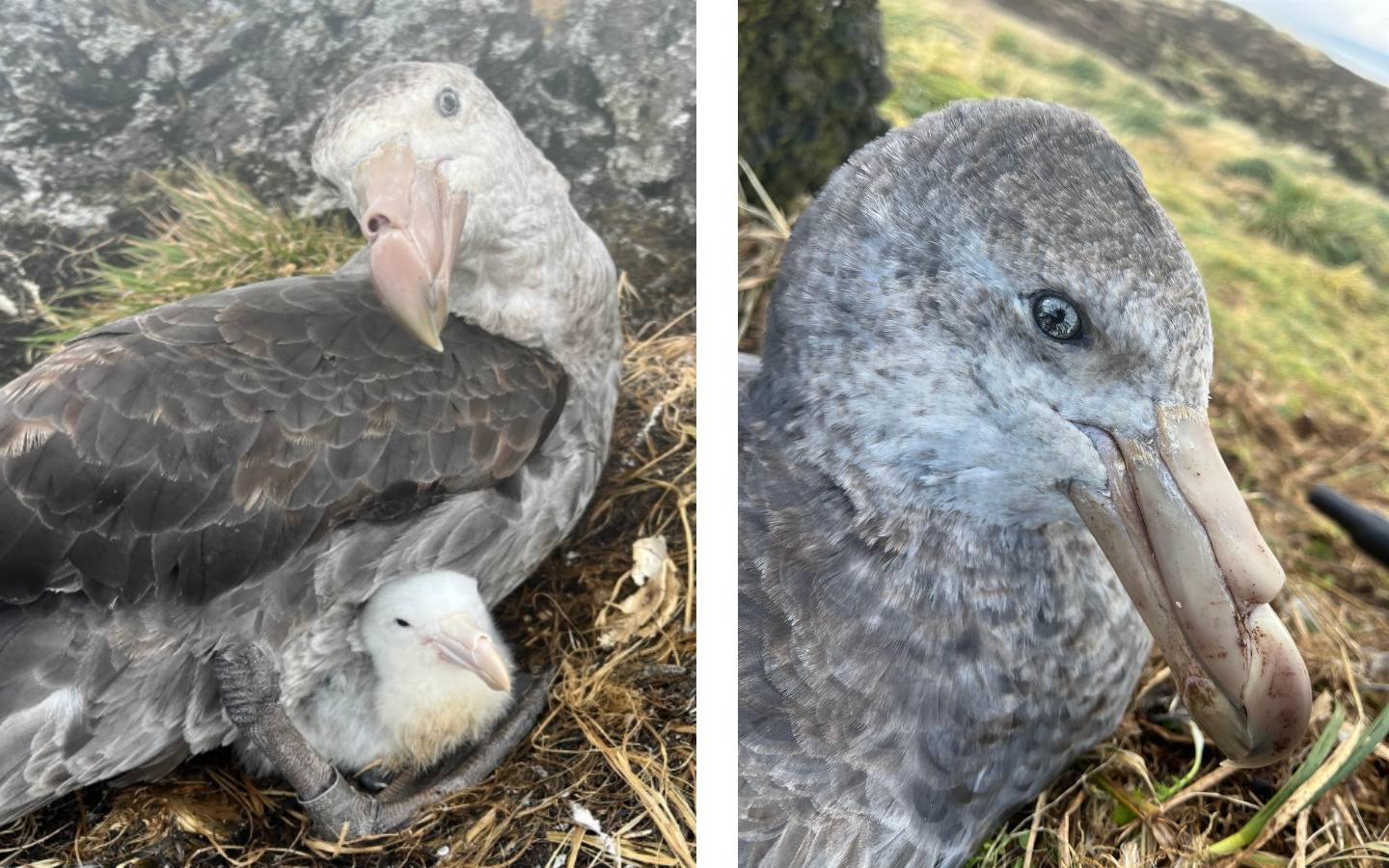
Northern Giant Petrels on Marion Island
This species has strong nest side fidelity, meaning that they often return to previous nest site locations to breed again. A total of 490 active nests were located during the 2025 island-wide incubation census. Despite being listed as Least Concern, breeding success in the monitoring colonies is low at only 42% (Feb 2026 data). Breeding success on the island has shown a general decline over the years with the current season showing the lowest breeding season over the last decade. This is very worrying. Egg loss following adult nest abandonment possibly due to temperature extremes (heat stress and heavy snowfall) and mouse bites are key challenges for these birds.
The coolest thing about these birds is their vocalisations – imagine a drawn out frog-like croaking sound, accompanied by swaying head movements and vibrating feathers on the back of the neck. These birds are also impressively cooperative during monitoring, some lifting a foot to reveal their ankle ring or chick when being approached.
Once fledglings of all three of these species leave the island, they will remain entirely at sea for several years. They usually return to land before reaching sexual maturity, prospecting at colonies for a few seasons, and only begin breeding once they are older and more experienced. In general, you can expect juveniles to first return at around ~6-8 years old for Grey-headed Albatross, ~4-6 for Northern Giant Petrels and ~5-7 for Walbies. So we don’t expect to see them back in a hurry!
A living warning from the ocean
From plastic fragments and long-line fishing hooks found in nests to fatal wounds caused by invasive mice and heat stress linked to climate change, the seabirds of Marion Island clearly reflect the sad state of our oceans.
The data we collect informs conservation policy, strengthens seabird protection efforts, and highlights the urgent need for responsible human activity, at sea and in the wider environment.
Life on Marion Island is demanding, remote, and often harsh, but witnessing fledglings take their first steps toward flight, seeing an endangered albatross chick hatch in front of you or having a curious Giant Petrel curiously nibbling at your knees, reminds us why this work matters.
Text and photos by Jana Rau and Andile Kuzwayo, SAPRI Seabird Field Researchers
Editing by Eleanor Weideman, Marine Apex Predator Research Unit, Nelson Mandela University
Anne Treasure, South African Polar Research Infrastructure, 15 April 2026