
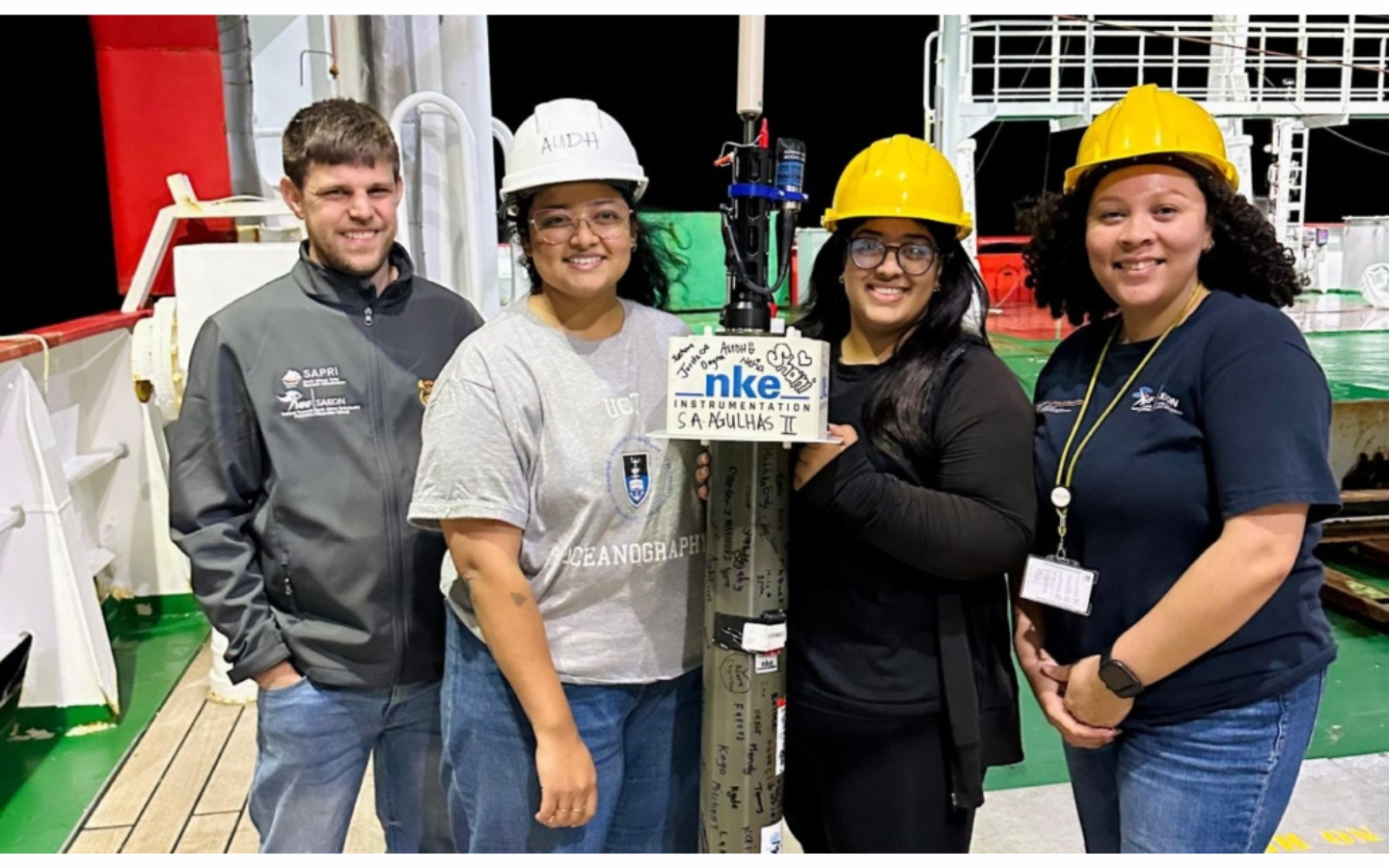
The Agulhas Current is a fast-flowing western boundary current that transports warm Indian Ocean water along the southeast coast of South Africa polewards. The current plays a key role in regional and global ocean circulation, influencing weather patterns, heat and salt transport and the distribution of marine life.
Due to its dynamic nature and its connection to broader climate systems, continuous monitoring of the Agulhas Current is essential for understanding how it responds to and influences environmental change. Monitoring this current provides critical data for improving ocean and climate models, forecasting regional weather events and managing marine resources. Studying such a powerful and variable system requires sustained and coordinated observation efforts.
Coast to Current: monitoring the Agulhas Current from Algoa Bay and Mossel Bay
During the recent voyage aboard the S.A. Agulhas II, two sampling transects were completed. The Coast to Current (C2C) monitoring line, which is an extension of an existing transect from an ACEP*-funded project based in Algoa Bay, serves as a key nearshore observation system for tracking how coastal waters interact with the larger Agulhas Current system. The project combines ship-based measurements, unmanned surface vehicles (USVs), autonomous platforms and satellite data to build a detailed picture of the oceanographic conditions in this transition zone where coastal dynamics meet deep-ocean processes.
The Mossel Bay Monitoring Line (MBML) forms part of the Department of Forestry, Fisheries and the Environment’s (DFFE) long-term monitoring efforts of the South African coastal ocean. The combination of these monitoring lines enhances our understanding of the South African coastal ocean and contributes valuable insights into the functioning of one of the world’s major ocean currents and its influence on South Africa’s marine environment.
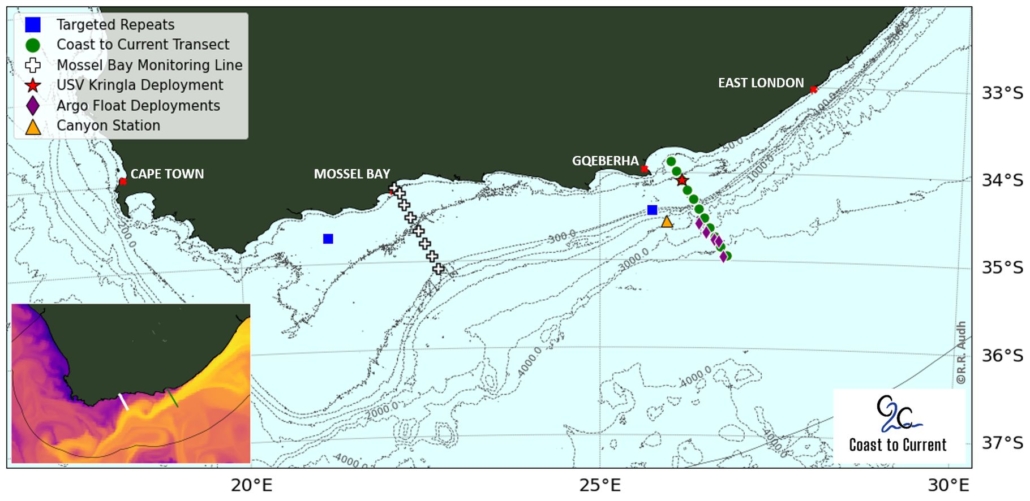
Map of the completed science stations and instrument deployments
During the voyage, the C2C transect extended from the Sundays River mouth across the core of the Agulhas Current, while the Mossel Bay Monitoring Line focused on high-resolution sampling of the shelf region extending from Mossel Bay. At both transects, a range of physical, chemical and biological parameters were sampled to capture the complexity of the region, including the Agulhas Current and its surrounding waters.
Conductivity-Temperature-Depth (CTD) casts were conducted at all stations to profile the water column and gather high-resolution data on temperature, salinity and oxygen. Simultaneously, water samples were collected from various depths for biological and chemical analyses, including macronutrient concentrations (such as nitrate, nitrite, phosphate and silicate), chlorophyll-a content, dissolved inorganic carbon, oxygen and samples for genomic studies.
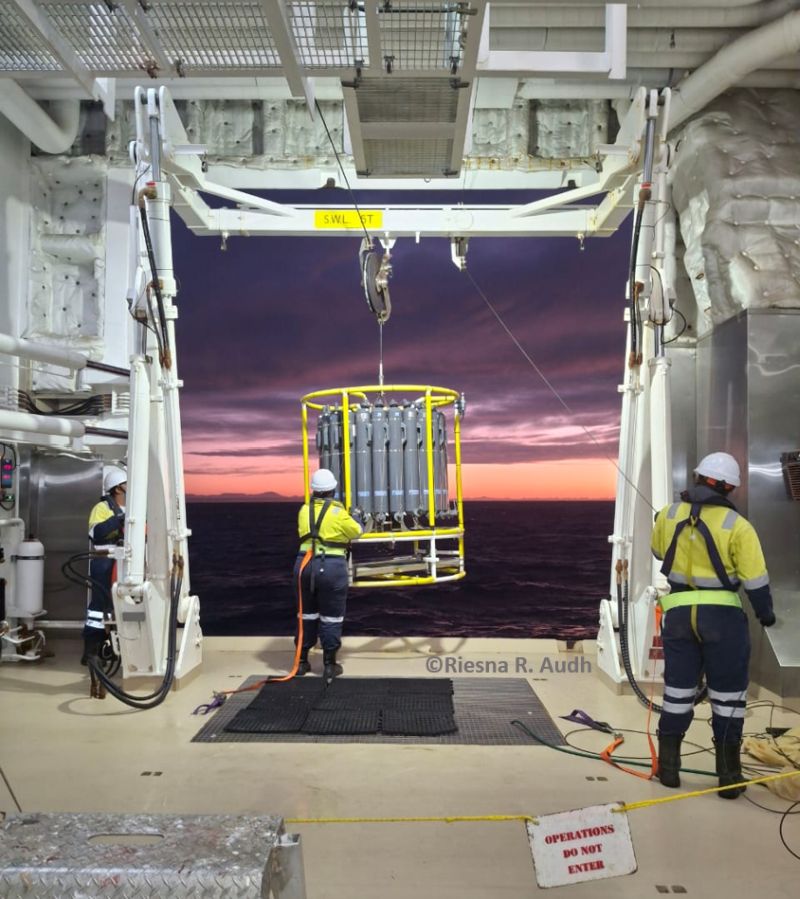
Conductivity-Temperature-Depth (CTD) (Photos: Riesna R. Audh)
In addition to the CTD and water sampling, phyto- and zooplankton sampling was carried out using bongo nets. Together, these integrated observations allow researchers to investigate the interactions between physical oceanographic processes and marine biogeochemistry, helping to unravel the role of the Agulhas Current in regional and global ocean systems.
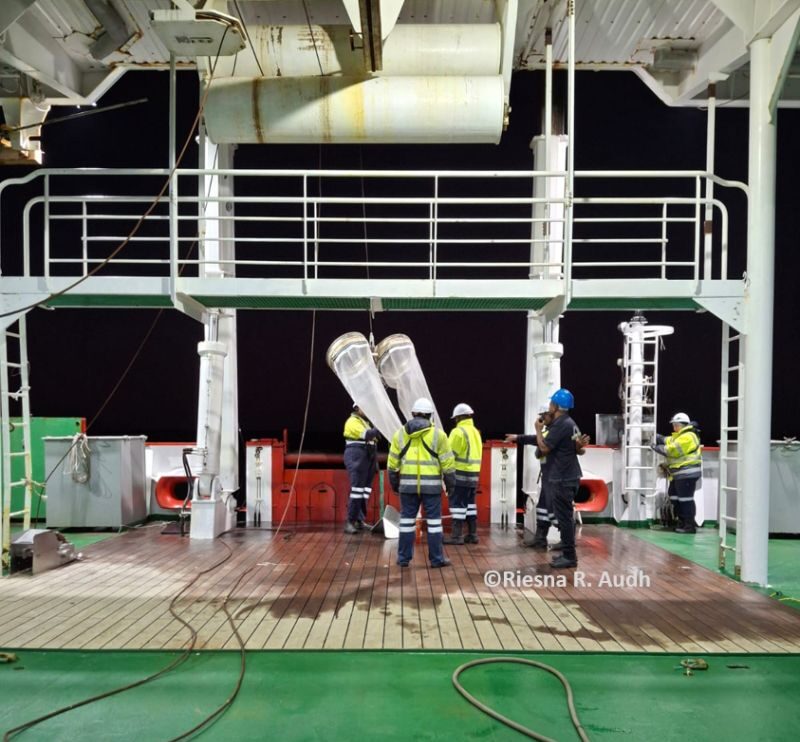
Deployment of the bongo nets (Photo: Riesna R. Audh)
In addition to the oceanographic science programme, the DFFE top predator team conducted continuous observations of marine mammals and seabirds, and the South African Weather Service (SAWS) team conducted continuous weather observations and provided the voyage with weather reports and forecasts that aided in navigation and planning. A researcher from Stellenbosch University (SU) conducted a study on human responses to the ship’s motion and environmental conditions, with all voyage participants acting as “human sensors”. Each day, participants completed a short survey documenting their individual experiences of the ship’s movement and how it affected them.
The NRF-SAEON and SAPRI team also deployed five Argo floats across the Agulhas Current, three from the German Argo team and two from the Woods Hole Oceanographic Institute (WHOI). The three German Argo floats were “adopted” by Rallim Preparatory School (ages 3–14 years) as part of an outreach initiative led by the NRF-SAEON Egagasini Node team. Additionally, a University of Gothenburg Sailbuoy, “Kringla”, was skilfully deployed as part of a PhD project. Unfortunately, due to the immense power of a storm system which passed over the region the day after deployment, “Kringla” needed to be recovered due to a broken sail.
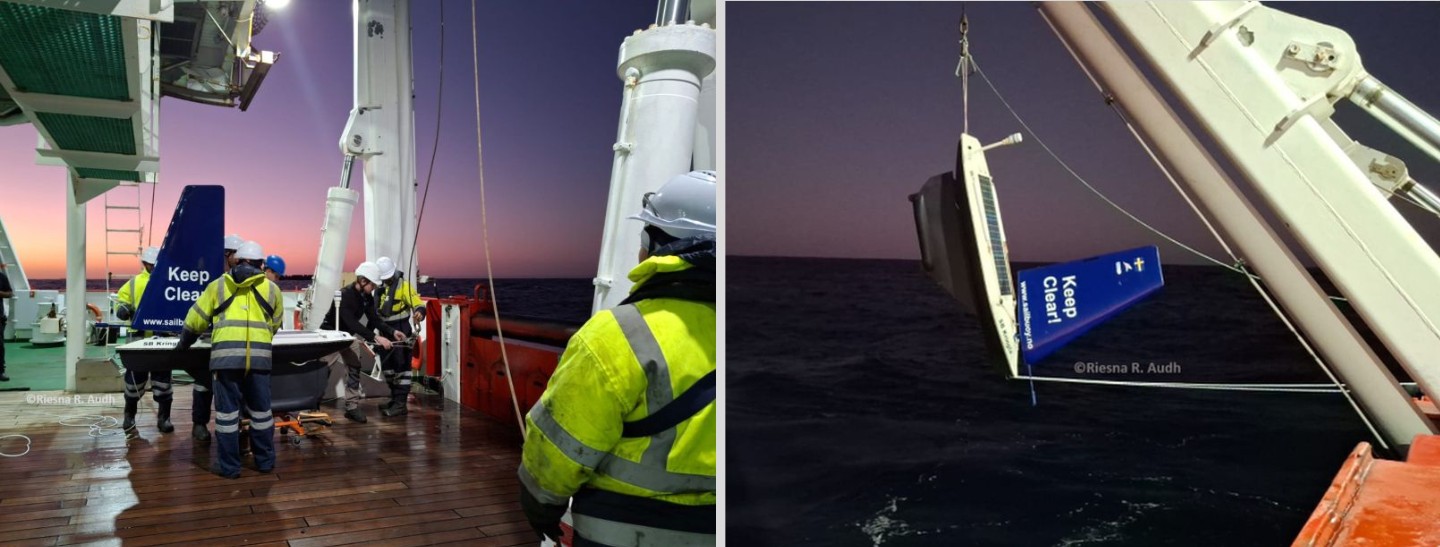
Deployment of the Sailbuoy “Kringla”. (Photos: Riesna R. Audh and Neha Ramsarup)
The science programme was supported by multiple institutions, including NRF-SAEON’s Egagasini and Elwandle Nodes and their respective research infrastructures – the South African Polar Research Infrastructure (SAPRI) and the Shallow Marine and Coastal Research Infrastructure (SMCRI), DFFE, Oceanographic Research Institute (ORI), Cape Peninsula University of Technology (CPUT), University of Cape Town (UCT), University of Pretoria (UP), SUN and SAWS. Additionally, technical support for scientific instrumentation was provided by a technician from Sea Technology Services.
This cross-institutional collaboration was essential to the success of the science programme, with teams supporting and assisting each other beyond their individual research objectives. Such collaboration ensured that the scientific programme was completed on time and with no significant issues.
SEAmester: South Africa’s class afloat
The SEAmester programme (https://seamester.co.za/) completed their eighth class afloat during the voyage. SEAmester provides students with a unique opportunity to experience and learn oceanographic principles, both theoretically and practically, aboard the S.A. Agulhas II.
This programme is designed to immerse South African students in real-world scientific research by bridging the gap between classroom learning and hands-on fieldwork.
As part of SEAmester, students engage in a rigorous schedule of lectures, practical sessions and research projects, all aimed at deepening their understanding of oceanographic processes. The scientists contribute to the SEAmester programme by interacting with the students and explaining their science as it happens during stations, be it during instrument deployments, sample collection, or while conducting onboard analyses. Students are also encouraged to assist scientists during sample collection, where possible. This hands-on involvement offers valuable practical experience and often sparks a lasting interest in ocean science careers.
For emerging researchers – especially MSc and PhD students from institutions like NRF-SAEON and UCT – SEAmester offers a truly unique and joyful opportunity to grow within South Africa’s oceanographic community. The voyage is more than just a research cruise, it is a hands-on classroom where the ocean is your teacher, and every sunrise deployment or late-night lab work becomes a moment of learning.
Being part of the SEAmester voyage allowed us to actively engage with both the scientific and operational sides of large-scale oceanographic research. From deploying cutting-edge instruments like Argo floats and the Sailbuoy “Kringla”, to participating in complex sampling operations, the experience was as technically challenging as it was rewarding. Whether it was troubleshooting technical issues on deck or adapting to life on a moving ship with rough seas and huge swells, each moment added to our toolbox of practical skills and real-world problem-solving.
What made the journey even more special was the strong sense of community onboard. There were endless opportunities to exchange ideas and learn from one another, whether during ship operations, impromptu deck-side chats or over a quick coffee between shifts. Simply being aboard South Africa’s state-of-the-art polar research vessel, the S.A. Agulhas II, added to the sense of pride and excitement that came with working at the forefront of ocean science. SEAmester does not just build capacity; it builds confidence, connection and collaboration.
Experiences like these truly nurture the next generation of South African oceanographers, equipping us not only with technical know-how, but with the resilience and teamwork needed to navigate the complexities of the marine environment.
This SEAmester voyage stands as a testament to the power of integrated research and experiential learning. Through dedicated scientific efforts and invaluable collaborative partnerships, the expedition significantly advances our understanding of the dynamic Agulhas Current system, while simultaneously fostering the growth of South Africa’s next generation of ocean scientists. The insights gained and skills imparted during this unique class afloat are crucial steps toward a deeper, more sustained engagement with South Africa’s marine environment and the future of ocean science on our shores.
Acknowledgements
We would like to extend our thanks to the chief scientist of the voyage, Mr Marco Worship (DFFE) and the DFFE team for their technical and sampling support during the voyage, as well as the captain and crew of the S.A. Agulhas II for their logistical support during the science programme and for all instrument deployments.
This article was originally published on the South African Environmental Observation Network (NRF-SAEON) website authored by Riesna R. Audh, Neha Ramsarup, Jordan Van Stavel and Jethan d’Hotman from the South African Polar Research Infrastructure (SAPRI) and NRF-SAEON (link).